
WEEE (Waste Electrical and Electronic Equipment) is a major environmental and logistical challenge for the recycling industry and for responsible materials management. In this article we find out more about what WEEE is, how it is managed, and what technologies are used to treat it.
WEEE can be derived from large, small household appliances, computer devices, lighting, audio and video equipment, medical instruments, and sports equipment.
According to European legislation (Directive 2012/19/EU), WEEE is classified into different categories and must be collected and treated separately to reduce environmental impact and recover valuable materials. In fact, some of these appliances, such as electrical and electronic equipment, may contain many materials, from precious metals such as gold, silver, and palladium to copper, iron, aluminum, and plastic. However, they can also contain potentially hazardous substances such as mercury, lead, and cadmium: this is another reason why proper recycling is necessary.
Treating WEEE in the right way therefore allows us to recover usable materials, prevent the release of pollutants into the environment with a consequent reduction in environmental impact, while complying with current regulations on special waste management.
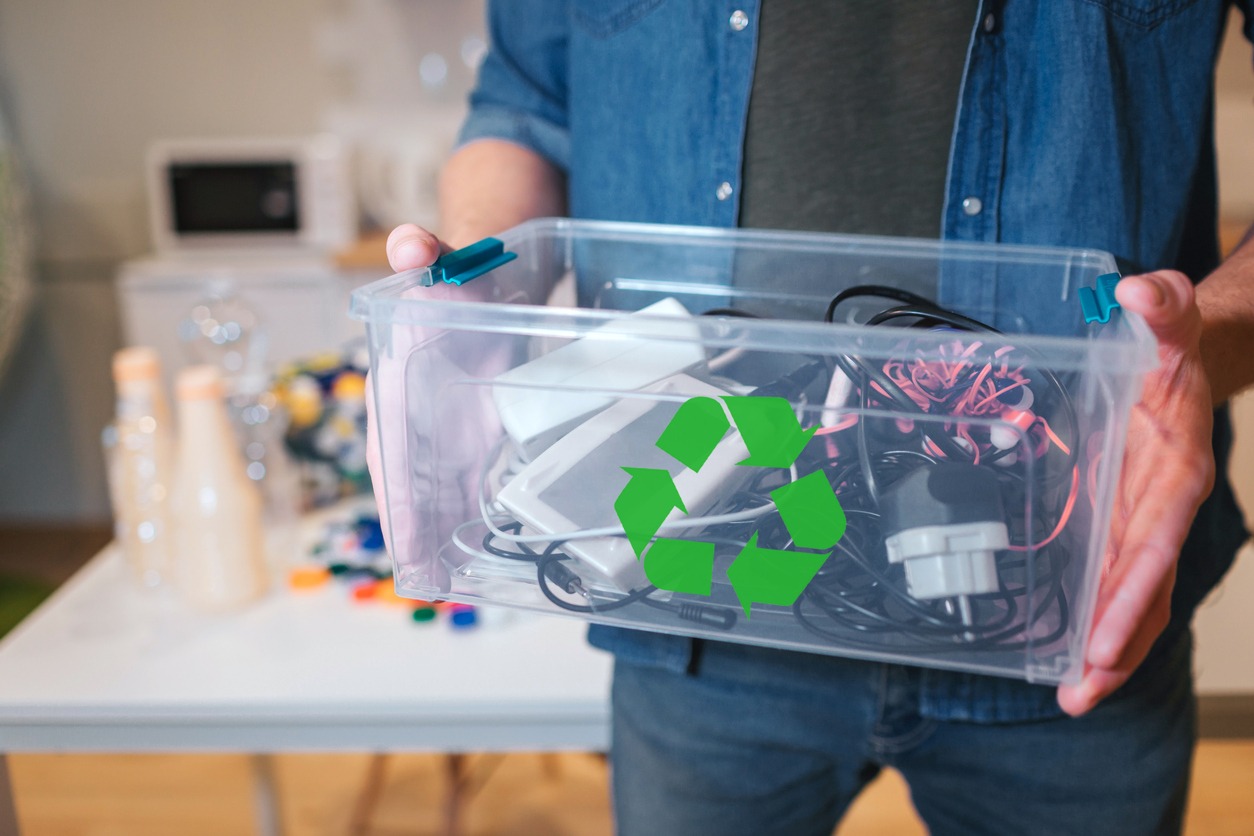
WEEE treatment
Let’s find out how the treatment and recycling of WEEE takes place.
The first stage is collection and transport: they must be delivered to authorized collection centers (ecological islands, municipal collection centers, distributors when buying a new product) and transported to specialized treatment centers.
The waste is then manually disassembled to remove hazardous components (e.g., capacitors, batteries, mercury-containing displays) and sorted by type and category. Compton Industriale has manual disassembly lines designed to make the disassembly and logistics of the resulting products as efficient as possible. The disassembly lines are designed according to the customer’s needs by configuring benches, manual or pneumatic equipment, conveyors, lighting, etc. according to the products to be disassembled and the number of people involved.
The third stage includes the processes of mechanical shredding and physical separation:
- magnetic separation to extract ferrous metals;
- eddy currents to separate nonferrous metals (copper, aluminum);
- flotation and other densimetric separation technologies to isolate plastic fractions.
Compton Industriale’s basic MCM-S line is designed to process small WEEE or electronic boards in a simple and economical way. The machinery uses the principle of disintegration to separate the various components of small WEEE or for volumetric reduction of electronic boards.
The last stage is refining. Recyclable material fractions (metals and plastics) are further processed and purified to obtain secondary materials ready to be reintroduced into production cycles.
Process efficiency and performance
Modern WEEE treatment plants manage to achieve recovery rates in excess of 85 percent by weight of the treated waste.
Efficiency also depends on the adoption of advanced separation technologies, such as those used by Compton Industriale.
In Italy, the WEEE sector is regulated by Legislative Decree 49/2014, which transposes the European directive. The decree establishes the responsibility of EEE producers in financing related waste management, traceability and reporting. Companies in the supply chain must also comply with stringent environmental certification and occupational safety requirements.
The treatment of WEEE contributes significantly to environmental sustainability and reduced consumption of natural resources. This sector plays a key role in the transition to a circular economy, and Compton Industriale is at the forefront, with increasingly advanced processes and highly automated facilities.